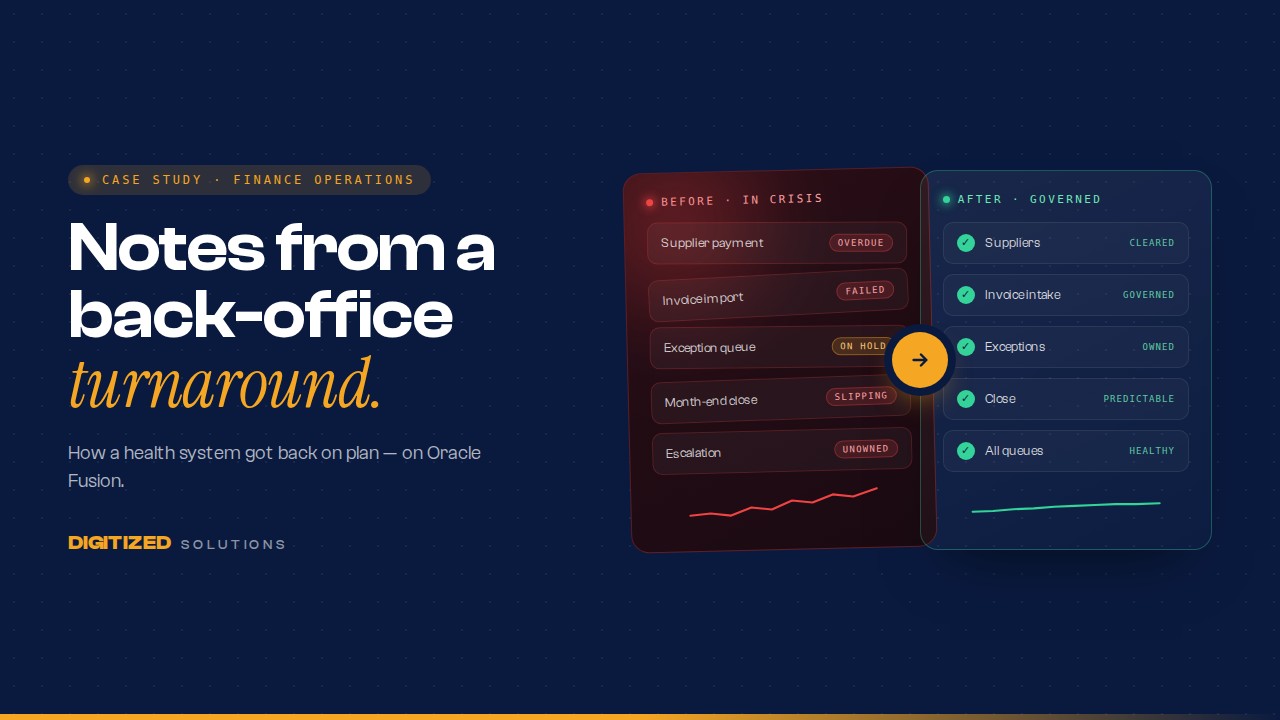
It rarely starts with a system alert. It starts with a question from a supplier: when are we getting paid? Then another. Then an email from the CFO’s office about whether month-end will land on time. By the time a back office is in real trouble, the symptoms have already left the Finance and Supply Chain teams and started showing up in the relationships the organization depends on. That is where this engagement began: an integrated health system, past its Oracle Fusion go-live, where the platform was running but the operation around it was not.
The organization & the context.
Our client was a large integrated health system, the kind of organization where the back office is never the point, and is never supposed to be visible. Care delivery is the mission; Finance and Supply Chain exist to keep that mission supplied and funded without anyone on the frontline having to think about them.
The organization had been live on Oracle Fusion for a few months, with the core financial and procurement functions running on the platform. The software worked. The implementation was “done” and live. But somewhere between go-live and steady state, the operation had drifted into a mode where every day was spent reacting, and the reacting was no longer keeping up.
What was actually breaking.
The signals were not subtle, and they reinforced each other:
- Supplier confidence was falling. Payments were running late, and the people who keep a health system stocked were beginning to ask harder questions about when, and whether, they would be paid on time.
- AP and AR backlogs were growing. Invoices accumulated faster than the teams could process them. Exceptions piled up in queues that did not always have a clear owner.
- Month-end close was slipping. Subledger issues and unresolved reconciliations pushed the close later each cycle, putting reporting and board-facing deliverables under pressure.
- Ownership was unclear. When an exception or an import failure appeared, it was not always obvious who owned it: the client, the implementation partner, or Oracle. Things fell between the seams.
Individually, each of these is a manageable operational issue. Together, compounding week over week, they become something else: a slow erosion of trust, both inside the Finance and Supply Chain teams and with the suppliers and stakeholders outside them.
That sentence framed the entire engagement. The goal was never just “fix Oracle.” It was to restore operational confidence before instability became a frontline problem, and then make sure it could not drift back.
How we approached it: a sequence, not a sprint.
We did not start with a transformation roadmap. When an operation is actively losing ground, the first job is to stop the bleeding, and only then to redesign. We ran the engagement as a deliberate sequence of four stages, each one earning the right to the next: Stabilize → Optimize → Automate → Scale.
Stabilize: stop the bleeding.
Stabilization starts with triage, not heroics. We began by categorizing every open issue and bucketing it by type: data loads, integration failures, exceptions, configuration gaps, and ownership gaps. With the work sorted, we ranked it by business impact and went after the highest-impact issues first. Where a fix could be engineered, we built it: integrations and scripts in Oracle Integration Cloud (OIC), targeted screens in Visual Builder (VBCS), and high-volume corrections through File-Based Data Import (FBDI). Just as importantly, we clarified ownership, so every exception queue had a named owner and the responsibilities split between the client, our team, and Oracle were explicit. Within weeks, the Finance and Supply Chain teams regained control: backlogs stopped growing faster than they could be cleared, and the daily firefight began to settle.
Optimize: redesign procure-to-pay.
With the operation no longer in freefall, we moved from reacting to designing. We walked the entire procure-to-pay process end to end, from invoice ingestion through to payment, and looked for every place it had grown more complicated than it needed to be. Then we simplified, personalizing the flow around how this organization actually works rather than forcing a generic template onto it: fewer steps, clear standards for how exceptions are handled, and documented ownership. The conversation across Finance and Supply Chain shifted from “what broke today?” to “how should this work going forward?” Supplier confidence followed, and terms with key vendors were re-extended.
Automate: give the teams their time back.
We replaced spreadsheet-driven monitoring with dashboards for AP, AR, and the close, and moved exception handling from a hunt to a managed queue. Pre-close validation surfaced issues earlier, making month-end more predictable. The effect on the teams was the point: the Finance and Supply Chain teams stopped spending their days investigating problems and started spending them analyzing the business, judgment work instead of detective work.
Scale: extend the model.
What began as a stabilization effort in AP became the operating model for the wider back office, extending across AR, reporting and analytics, account-combination governance, and an ongoing, senior-led support cadence. The engagement turned from a rescue into a standing partnership, with a clear roadmap for the streams that come next.
What changed.
We are deliberate about not dressing this up with invented metrics. What we can say plainly, and stand behind, is directional and real:
- The operation regained control. The growing-backlog spiral was halted; work stopped accumulating faster than it could be cleared.
- Supplier confidence was restored. The most critical relationships were brought current and stabilized, and terms with key vendors were re-extended.
- Month-end close became predictable. Earlier visibility and pre-close validation took the recurring drama out of the cycle.
- Ownership became unambiguous. Every queue had a named owner, and the line between client, partner, and Oracle responsibilities was clear.
- Stabilization became governance. A crisis response became the durable way the organization runs and oversees its back office.
Why the sequence worked.
The instinct in a situation like this is to jump straight to the redesign: new workflows, new automation, a better target state. But you cannot optimize an operation that is still losing ground, and you cannot automate a process nobody owns. Stabilizing first bought the credibility and the breathing room to do the rest properly. Each stage made the next one possible.
That sequence, Stabilize → Optimize → Automate → Scale, is not a framework we invented for a pitch. It is the path this engagement actually took, and it has become the way we think about back-office work on Oracle Fusion: earn stability, then earn improvement, then earn leverage, then make it last.
Is your Oracle Fusion back office in a firefight?
If supplier escalations, growing backlogs, or a slipping close sound familiar, we are happy to walk you through how we would stabilize it, on a 30-minute call.
Book a discovery callA note on this case study: it is based on a real Digitized engagement. To protect our client’s confidentiality, the organization is not named and all identifying details have been anonymized. We describe outcomes directionally and have deliberately avoided publishing specific figures, such as backlog counts, close-cycle days, and similar metrics, that we are not in a position to disclose. The accompanying console visuals are illustrative representations of the work, not screenshots of the client’s system.