Three months. One Friday morning. A test environment refresh that — if you let it — becomes a fire drill, and a production cutover that arrives whether you are ready or not. That is the rhythm of Oracle Fusion Cloud quarterly updates. We have been on the inside of dozens of these cycles, and the difference between teams that thrive on the cadence and teams that white-knuckle every release is not tooling. It is a calendar. So here is the calendar.
How Oracle organizes the cadence.
Oracle Fusion Cloud customers are organized into three update cohorts — A, B, and C — staggered across the year. Each cohort receives the same release content, just on a different schedule, so Oracle can roll out features without putting every tenant under the same maintenance window simultaneously.
In our work over the past several years, every Digitized client environment has been on Cohort A. The 2026 calendar below is the one we use to plan our engagements. If you are on Cohort B or C, the cadence is the same — one quarterly release, a two-week testing window between test and production updates — but the dates shift by a few weeks.
If your current cohort does not fit your business calendar — year-end close, peak season, finance audit windows, an ERP-adjacent rollout — our understanding is that Oracle will generally allow a switch. Reach out to your Oracle account representative to start that conversation. The earlier the better; cohort assignments are not changed overnight.
The Cohort A 2026 calendar.
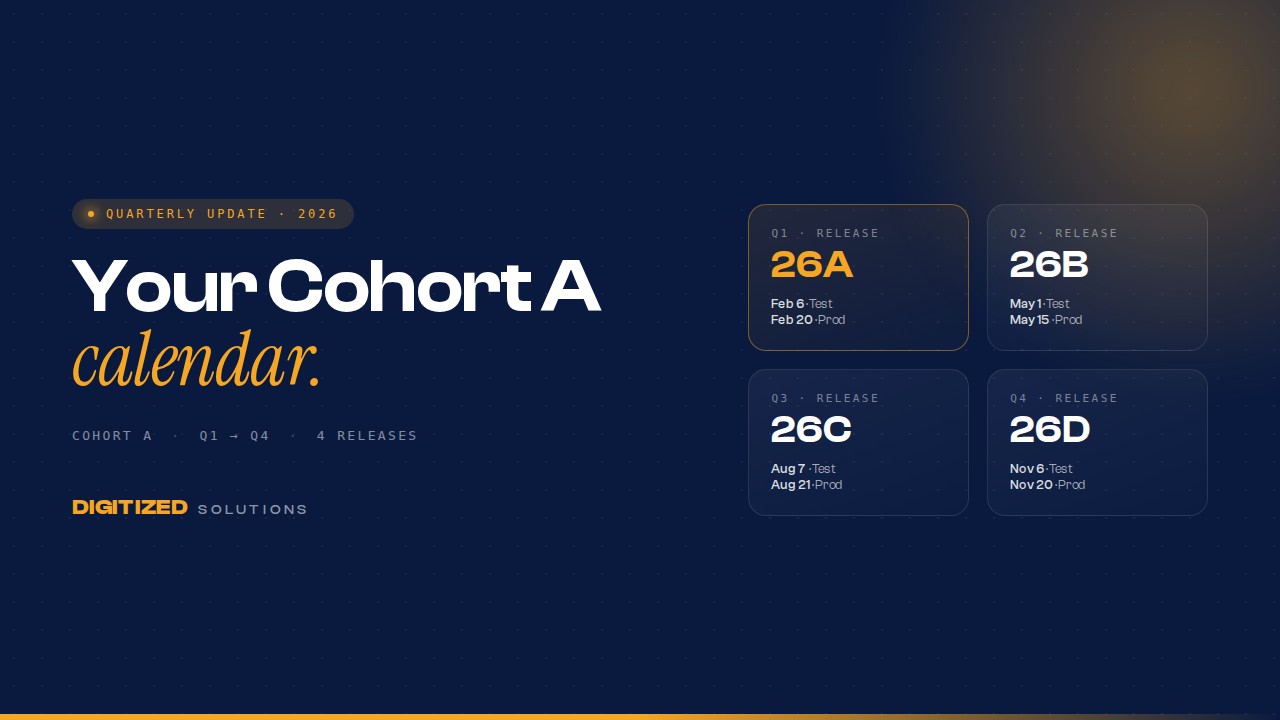
Four releases, evenly spaced. Each one follows the same three-step rhythm: test environment refresh on the first Friday of the release month, a two-week testing window, then production cutover on the third Friday.
Here are the exact 2026 dates:
| Qtr | Release | Test (1st Fri) | Production (3rd Fri) | Testing window |
|---|---|---|---|---|
| Q1 | 26A | Feb 6 Friday |
Feb 20 Friday |
Feb 6 – Feb 19 |
| Q2 | 26B | May 1 Friday |
May 15 Friday |
May 1 – May 14 |
| Q3 | 26C | Aug 7 Friday |
Aug 21 Friday |
Aug 7 – Aug 20 |
| Q4 | 26D | Nov 6 Friday |
Nov 20 Friday |
Nov 6 – Nov 19 |
Print this. Pin it. Build your Q1 close plan around it. The 26A release in particular — Oracle's “year of” release — carries the largest changeset of the year, and we always recommend padding the regression window by an extra few days for it.
What we have learned running this cadence.
A short list of patterns from the engagements we have run. Not theory — field notes.
- Do not try to test everything. Test the processes that matter: the close cycle, the supplier hold workflow, the procure-to-pay loop, your custom integrations, anything that touches month-end revenue recognition. Everything else is regression theatre.
- 26A carries the biggest changeset of the year. Plan for it. Most clients get away with three days of testing per quarter; 26A is the one to schedule a full two weeks.
- Read Oracle's What's New documentation on the first day of the window. Almost every nasty surprise we have seen was disclosed there — teams just did not read it before the production cutover.
- Build a release readiness checklist once and reuse it every quarter. The teams that win at this run the same playbook every cycle. Predictability is the whole point.
- Document opt-in features deliberately. Oracle ships plenty of features behind feature flags. The point of testing is not just to confirm nothing broke; it is to decide which new features your team adopts.
How Digitized helps with this rhythm.
Our Quarterly Update Readiness (QURE) service is built for this exact cadence. Two weeks before each test refresh we hand clients a release readiness plan: what changed in the release, which business flows are exposed, the regression scope, the suggested feature adoptions. During the two-week window we drive the testing against those flows. After production cutover we produce a clean post-release report so leadership knows what changed and why.
If quarterly updates have become a recurring fire drill for your team — or if you are heading into 2026 wanting a more predictable cadence — we are happy to walk you through how QURE works on a 30-minute call.
Walk into the next release knowing what changed and why.
A two-week head start, a clear regression scope, and a clean post-release report — every quarter, on the same playbook.
Book a discovery call